
 RSS
RSSXgau Sez
These are questions submitted by readers, and answered by Robert Christgau. New ones will appear in batches every third Tuesday.
To ask your own question, please use this form.
February 15, 2023
[Q] The recent question about Bolaño elicits in me a keen desire to know more about the novels you've consumed. Ideally we'd get your top 10 for every calendar year--we know you are not averse to annual lists as such--but I'll happily settle for 20 good novels people may be less familiar with. -- Martin, Cleveland, Ohio
[A] How about 11? Most longish, two quite brief, several I've written about including three in Going Into the City, one you've seen the movie of (which ain't bad), three by writers I've reviewed in the Voice, three by writers of color, a few particularly the all too unsung Drabble read like butter and a few don't come close.
- Alejo Carpentier, Reasons of State
- Roddy Doyle, The Commitments
- Margaret Drabble, The Millstone
- Theodore Dreiser, Sister Carrie
- V.S. Naipaul, A House for Mr. Biswas
- Ishmael Reed, Mumbo Jumbo
- Kim Stanley Robinson, 2312
- Henry Roth, Call It Sleep
- Norman Rush, Mating
- Ousmane Sembene, God's Bits of Wood
- Christina Stead, The Man Who Loved Children

January 18, 2023
The limits of lists, the power of craft and wisdom over time, the vocal brilliance of Charley Pride, the educational playfulness of Sophie, '2666' remains on the shelf, & middle ground for socialism.
[Q] Rolling Stone's top 500 albums underwent quite a shakeup from both previous versions in their update last year. The concept of "ranking" albums, especially across artist, decade, and genre, is too complex for me to seriously consider. I can argue why Aftermath is better than Let It Bleed but don't ask me to compare either of them to In a Silent Way. Still, as far as choices go, Rolling Stone's choice of What's Going On is an odd one. Even in its own offbeat, stoned universe, it is far from perfect (an A for me). Do you think these lists have any utility? Is there a way to create a list that you would prefer? -- Jacob H, Minneapolis
[A]
It's nice to have a new reader, as I assume you are because I've
complained about the
overrated What's Going On
many times, although note that
the mag didn't "choose" it as number one, it ran a poll in which it
was voted number one. Moreover, I wrote a piece about the
Stone list for And It Don't Stop that ran in
September 2020, and filed
another about Stone's much later
singles list. As for the
greatest singers thing the mag recently put on the newsstands, which
several readers have inquired about, the truth is that I've yet to
read it bottom to top but would probably lead off any such list of my
own, which at the moment I have no interest in concocting, with
Frank Sinatra and Billie
Holiday, both high on the Stone list but not high enough.
[Q] Bill James has done studies that track the average performance of baseball players by age. I haven't seen studies like that of musicians and probably never will because we don't have statistics for them like we do for ballplayers. (We do have your grades, though!) Without getting too rigorous, it still seems to me that the average peak age for rock musicians is probably about what it is for athletes--around 27ish. I wonder if you agree, and if you'd expect those abilities to rise and fall together if you take a long view of them. I wonder who would be your picks for outlier rock musicians who did their best musical work after 30. Your marks suggest that you might regard Bruce Springsteen and Bob Dylan as examples. -- HB, NYC
[A]
This seems wrong to me. For sure many bands and solo artists come off
the blocks young and never quite equal that pitch of intensity
again--many would say Dylan though I wouldn't, Ramones, Stooges,
Beatles too although Lennon's
Plastic Ono Band came when
he was 29 and I'm a big fan of
Double Fantasy 10 years
later. But 27 is way young for an "average peak age" even though
Joplin and Hendrix died at 27 and Kurt Cobain later joined what his
mother called "that stupid club" (and Otis Redding went down in a
plane crash at 26 and Buddy Holly at just 22, which renders neither
any kind of burnout). A minute or two of brainstorming reminded me of
Exile on Main Street and
Some Girls, post-30 Stones
masterpieces both. For my money
Sonic Youth and
Yo La Tengo were better past 30
than they were before. Neil Young did his best work in his thirties
and then kept going, and note too that even Chuck Berry's "Maybellene"
broke when he was just shy of 29 and a bunch of his greatest songs
were written in prison when he was pushing 40. General conclusion:
especially for individuals but often for whole bands, the pop music
labeled "rock" generally turns into a career, and while the excitement
may well wane, craft and wisdom often compensate.
[Q] Did Robert Christgau know Charley Pride? -- Robert Mazzella
[A] If by "know" you mean personally please be advised that this is a silly question. I meet very few musicians, and though usually I like them when I do, the only one I know well is Peter Stampfel, a friendship that began well after his professional peak such as it was. True, in recent years I've developed warm acquaintanceships with a few artists whose careers I helped boost early, notably Adam Weiner of Low Cut Connie and the Wussy karass. But even so that's just not how my life works. That said, Pride was a worth mourning when he died two years ago, and musically I stand by the best-of review you'll find just below, although I'd amend it to say that racially Nashville has opened up a little in the two decades since I wrote it.
Charley Pride: RCA Country Legends [Buddha, 2000]
Voicewise, as brilliant as Vernon Dalhart, Ray Price, George Jones. Contentwise, as wan as Red Foley, Ronnie Milsap, Eddie Rabbitt. Only for Pride, wan was perverse. A deeply ambitious sharecropper's son who moved up to Montana to pursue his first love, baseball, and settled for a job smelting zinc, Pride didn't stand out because he could dip from tenor to bass in well-enunciated middle-American smeared with drawl and flanged with vibrato. He stood out because he wasn't white. Although it wasn't easy becoming the only black country star ever, once he got over the hump he was the perfect token for Southern traditionalists eager to find safe common ground with the civil rights movement. Stylistically honky-tonk when Nashville was trying to be modern, he was never thematically honky-tonk--no drinking songs, God knows no catting songs. Yet his skin color was inescapable. From this Mississippi emigre the pro forma can't-go-home-again of "Wonder Could I Live There Anymore" was an indictment, "voice of Uncle Ben" and all. And how to read the cornball complacency of "I'm Just Me": "I was just born to be/Exactly what you see/Nothing more or less/I'm not the worst or the best/I just try to be/Exactly what you see"? Early on some well-wisher suggested he bill himself George Washington Carver III. But that would have been taking on airs, he'd stick with his own name thankee, and look what it was. Belated Country Music Hall of Famer Pride no longer tours regularly. He doesn't have to. He owns a bank. A−
[Q] Hello, just wondered if you've thought about Sophie's all-too-small output in her brief time on earth since her passing. Personally, it was comforting to hear that her saddest song was permission to just cry, for whatever reason life provides. Ultimately, I saw her vision as one of an uplifting spirit that affirms both dancefloor euphoria and transhumanist folly. If a lot of queer art is just a bugle from the aftermath of a war, however well played, then Sophie could be the one that sounds most triumphant. Make of that last proclamation what you will, guess this is ultimately just another one of those "What do you make of this artist?" requests. With all due respect to your health and time, all my best to you and all you hold dear, and thank you for everything. -- Jen Friendship, Brisbane, Australia
[A]
I liked both of Sophie's albums
quite a lot, their playfulness
especially, and was quite saddened to read of her accidental death two
years ago. That said, I can't claim to have put them on since--her
cultural frame of reference isn't mine, which makes her playfulness
educational and even enlightening but less personally compelling than
it might be. That said, I listened to both twice with pleasure upon
receipt of this question, although I continued to find the clotted
"Pretending" a waste of time.
[Q] I hope you read 2666. You deserve the pleasure. I wish you dug Tull but that's a whole other issue. Thanks for your work. Very appreciated by me. -- Bernie Kellman, San Francisco
[A]
I read 40-50 books a year, but that requires discipline, and throw an
1100-pager into the mix and it becomes pretty much impossible. Longest
of 2022 was my continued-from-2021 third read of the 800-plus-page
The Brothers Karamazov, the first two when I was in my teens so
that like Crime and Punishment it played an enormous role in my
spiritual development that I thought it would be enlightening to
revisit, which it was. I also got through David Graebner's 500-plus
and rather less fast-moving Debt: The First 5,000 Years. In
2009 I read Bolano's 648-page The Savage Detectives and came
away impressed and enlightened, particularly as regards Mexico. But
2666 I left to my fiction-oriented novelist wife Carola, who's
imbibed a lot more Bolano than I have and recalls that after the long
and harrowing rape section toward the end, which she admired and
admires tremendously, she was too spiritually exhausted to continue
and never went back. So the pleasure you suggest if that's the right
word will probably remain beyond my ken. Although not as far beyond my
ken as Jethro Tull.
[Q] Capitalism or socialism? -- Anonymous, United States
[A]
If those are my only choices, socialism of course. But as you seem
suspiciously unaware in your anonymous way, perhaps because you think
capitalism is the only right answer and want to provoke me, they're
not. I refer you to
"Dark Night of the Quants," a 2011
Barnes & Noble Review column conveniently collected in my
2018 Duke University Press Book Reports, where I report on 10
books about the 2008 financial crisis, one of them summed up thusly:
"Ha-Joon Chang, 23 Things They Don't Tell You About
Capitalism. South Korean-born British economist loves Swedish
capitalism and hates the free-market kind. Like most liberal
economists, not much use on political implementation of his sane
proposals. A−" Which is to respond, there is a middle ground, and
Chang explains it very well.
December 21, 2022
Music without distraction, the Kanye question, liking what you like, murder most foul, being a long-haired Clash fan, and Courtship 101.
[Q] Hi Christgau, I love to listen to music when I write. I know you say you're basically always listening to music, but do you reach for instrumental/foreign-language albums when you want to concentrate? I find that vocals sung in a language I understand can be distracting to my writing. What are your top albums for getting some heavy critical work done? Thanks, love your stuff. -- Cas McKenna, Albuquerque
[A]
I don't find lyrics distracting except when they are, which is usually
a sign of quality, although not necessarily a decisive one. For over
50 years I've run music through my head at every opportunity while
almost never finding it a distraction, lyrics or no
lyrics. Professionally and going back to when I was a teenager with
the radio on, the whole point of nonstop music for me is to find out
what insists on closer attention, on being consciously heard, which
needn't be lyrics by any means but when it is matters big-time, so
that I often go back to concentrate harder on a second pass at a verse
or chorus. Admittedly, however, this happens more often when I'm
cleaning up the kitchen than when I'm trying to eke out my next
sentence.
[Q] What do we make of Kanye's latest antics? This isn't the first time one of my heroes has let me down. Learning of Chuck Berry's misdeeds truly broke my heart. But I've always been able to separate the art from the artist. I am still able to enjoy Chuck's lyricism and his riffs, the memories associated with them, and what they mean for rock and roll. But what about Kanye? Whose personality is so central to his music? Honestly, it's been hard to listen to him again after all the hate he's been spewing. -- Alfonso Godoy, Tegucigalpa, Honduras
[A]
I've barely listened to Kanye since determining that
My Beautiful Dark Twisted
Fantasy belonged in my
best-of-decade list a few
years ago, which was before he lost his musical mojo whilst shoving
his cruel and clueless current politics in our collective
face. Couldn't get through Donda, by which time I felt no obligation
to. The
early records remain great; I'm
not even sure they'd hint at his madness were I to try to go back and
find it there, which I won't because fuck him. His presidential run
appalled me even before one of his electoral votaries ruined the lives
of two hard-working black and female south Georgia election officials
on top of everything else. Delusory Trumpy paranoia with anti-Semitism
on top is not a forgivable personality quirk--as it's often said in
his defense, it's a sign of mental illness. There are those who
believe this illness deserves our attentive compassion in part because
he was and in some respects may still remain a genius. Not me. Having
lost interest in his "personality" at least a decade ago, I suppose
it's possible he'll become sane or anyway saner again. But I never
identified personally with his genius--just enjoyed the musical
consequences and hoped he'd make something socially useful of it,
which he never did. And Jesus is in no position to help him now
because Jesus never was.
[Q] When you started writing about music, rock was seen as bohemian and progressive. Now the kids see it as old-fashioned dad music. All the hip critics scorn it as white male cultural appropriation of black music. (I get the poptimist argument, but I'm just not into their kind of music.) Everyone assumes that it's on the way out. I feel like an old fart for loving it, but love it I do. You're older than I am. How do you justify loving to the kids these days? -- Richard, Washington D.C.
[A]
I don't know what you're talking about. What "hip critics"? Do "hip"
people even say "hip" anymore? For that matter, do they say "rock"? I
count maybe seven what I'd call "rock" records among my provisional
2022 A albums so far: Gogol Bordello, Drive-By Truckers, Superchunk,
Derek Senn, Terry Klein, Amyl and the Sniffers, Paranoid Style,
arguably Emperor X, how about Craig Finn or Bonnie Raitt, maybe Wet
Leg or the Beths or the Mammoth Penguins although perhaps you think
the last three are too femme and/or "pop" to make the cut, although
how anyone could think Paranoid Style much less Amyl and the Sniffers
aren't "rock" I can't imagine. So right, Archers of Loaf was a
disappointment. Then what? Did the lamentable Foo Fighters put out a
record I forgot about in 2022? The even duller 1975 did, right? Do
"hip" people really apply the so self-evident they verge on stupid
racial points to newer bands? Do they now disallow let's say the
Rolling Stones and Led Zeppelin altogether on those grounds, which in
those cases and many others have been explicitly understood for half a
century without meaningfully diminishing their aesthetic originality
or bohemian-progressive stature in a history that has of all things
moved on with the years? If "the kids" can't hear that originality am
I supposed to waste my time explaining it for the umpteenth time,
almost certainly to no avail? Like what you like and don't worry about
being "hip." Hip is a snake pit.
[Q] I have just a small question. Do you have a personal top three songs about killing your girlfriend/spouse? Mine are: "IYDKMIGHTKY," Type O Negative; "Maxwell's Silver Hammer," the Beatles; "Time of the Preacher," Willie Nelson. P.S. I had to limit myself to one Type O song. They are all so good! -- Hig Hauer, San Luis Obispo
[A]
Though I can't find it in myself to blame Nelson for trying his hand
at that immemorial American folksong subgenre the murder ballad, a
mode I've never had much use for myself, I will note that "Time of the
Preacher" is the lead track of what I long ago called Nelson's most
overrated album,
Red Headed Stranger. If I
ever noticed that "Maxwell's Silver Hammer" was about a bad boy
bashing people with an expensive toy, I'd forgotten, though I admit
McCartney does fairly well with an inscrutably mock-ironic tone that
renders the song a one-shot in his vast if oft lightweight
catalogue. As for Type O Negative, if you're telling some version of
the truth about your deep love for this band I urge you to seek
psychiatric counsel at your earliest convenience.
[Q] During what years did you have long hair, and what made you decide to chop it off? -- Nicholas Cox, Cambridge, Massachusetts
[A]
I grew my hair out only in late 1967, which means I wasn't much of a
pathfinder, only then stubbornly not to say perversely refused to cut
it in the punk years. As a Clash groupie pointed out to me in French
after their amazing late-'77 Leeds concert: "Tu as les cheveux
longues." Two-and-a-half years later, however, Carola and I underwent
a marital crisis in the wake of five years of infertility trauma, and
as often happens to people in such fraught moments I decided to cut my
hair. Felt good. Have been patronizing the same barber ever since.
[Q] Do you like the Quicksilver Messenger Service? Songs not albums. If not, why send it to Carola? -- Milan Nikolich, Belgrade, Serbia
[A]
As I keep saying, people like what they like, and if one of them
happens to be the most winsome woman you've ever met and the
appropriate memorabilia comes your way, you give it to her to let her
know she's both entitled to her own opinion and on your mind. That's
just Courtship 101. Wrapping that promotional Quicksikver kite up for
the mail was actually kind of tricky. But the effort I made to send it
to Carola was one of the smartest things I've ever done. I've since
introduced her to years of music she likes way more than she ever
liked Quicksilver.
November 16, 2022
À la recherche du temps perdu ('50s edition), worthwhile Canadians, Taylor v. Joni, Sarah Palin v. Jeffrey Lewis, and the electric kool-aid Dock Ellis revelation
[Q] Any chance you'll write a '60s or '50s rock book? Any chance you'll write today's concept of what that time was about? You said (one time long ago) the transition between '50s and '60s was endlessly complex. Sounds like a book or two, to me at least. -- Milan N, Belgrade
[A]
Oddly enough, a history of '50s rock and roll--please not '60s rock, a
far vaster and less coherent subject--went on my agenda around the
time I began teaching at NYU in 2005, because it quickly became clear
that my students knew next to nothing about it. I even wrote a Barnes
& Noble piece musing about this lacuna, and designed a '50s course
that I taught at NYU in 2015. If I didn't have my Substack gig I might
even be working on it, though later I came up with another book idea I
might also have pursued. But I do have my Substack gig, and it's very
nearly a full-time job, and I'm 80, and the love of my life thinks I
work too hard. So don't hold your breath.
[Q] What is your opinion of the early albums of Bo Diddley and Chuck Berry on Chess? I know you've recommended greatest hits albums by both artists but I'm curious if you think their individual albums hold up themselves. No question that there is a mediocre track or two on each of their albums but the overall consistency and originality of Berry albums like More Chuck Berry and St. Louis to Liverpool and Chuck Berry Is on Top and of Diddley albums like Bo Diddley Is a Gunslinger and Have Guitar Will Travel and Bo Diddley Is a Lover amazes me and I wonder if you feel the same. -- Scott, New York City
[A]
Since I'm old enough to own both Bo's great Robert
Palmer-curated/annotated Chess Box and Bo's The Definitive
Collection, which I recommended to Blender readers 15 year
ago ago after Chess Box went out of print and which are now
both collectors' items, those are what I play. But note too that early
Bo is old enough to be available in one of those cheap multi-album
gray market European packages that as copyrights expire are now
surfacing on a lot of Black music from the '50s, and I bet all that
music is pretty good. Nonetheless, I'm happy with what I've got, so
I'll leave my Bo advice there and if you prefer to mine Discogs be my
guest. As for Chuck, I'm old enough to own his Chess Box too,
but generally I go to either the great The Definitive
Collection or else something post-Chess: Chuck, the 2021
Live from Blueberry Hill, recently 1979's Rockit
too. Since you ask, The Definitive Collection includes
everything I find worthwhile from Chuck Berry Is on Top.
St. Louis to Liverpool is several shades better. But given
how much other great music is out in the world, in my opinion life
is too short, and not just if you're 80, to devote too much time
to these fine distinctions.
a
[Q] American/European media dominates. The number one radio station in Central Ontario plays mostly American, but you can always count on at least one song by "The Hip" or the song "Go For a Soda" to help reach the Cancon quota. Other than that, mostly AC/DC. The only other popular stations are country. You won't happen upon any Sloan or Teenage Head by turning a Canadian radio dial. You stumble upon that stuff either by reading, or through your Dad. Government funded art programs help local acts release a cassette or slightly bigger ones have any career at all, but everything worthwhile gets buried by the Hip. Newer music is only played on the radio through particular campuses or occasionally on CBC. Is this a case of the old deliberately ignoring the young? Ps. Here's a list of worthwhile Canadians that nobody's dad stands up for: Tops, Baby Labour, Fet.Nat, Lido Pimienta, Luge, Ian James Bain, Keita Juma, Black Dresses, and New Fries. -- Justin Grignon, Petersborough, Ontario
[A]
If you say so. Having just isolated a Canadian act I like a lot that
you did not mention, Mama's Broke, as well as discovered that Buck 65
had returned, I'll wait and see if anyone on that inconveniently long
list makes an impression.
[Q] Taylor Swift > Joni Mitchell. Thoughts? -- Nicholas Wanhella, Vancouver
[A]
As these silly mind games go, this strikes me as a good one, which is
why I've agreed to play. In terms of schooled skill and raw talent,
your > isn't a crazy notion at all, at least by me, because I
happen to be both a longtime admirer of Swift, who in 2008 started
getting nothing but A's save one B plus, and a Joni skeptic, with
little if any use for the vast preponderance of albums that followed
her extraordinary 1970-74 run of Ladies of the Canyon,
Blue, For the Roses, and Court and Spark: The
Hissing of Summer Lawns, Don Juan's Reckless Daughter, and
the misbegotten Mingus seemed half-assed at best and much of
what followed was worse than that. Many people I like and mightily
respect have loved that post-Court and Spark music, especially
the first three--Eric Lott and the late great Karin Berg come to
mind. But for me the records kept getting worse except for the superb
2000 covers album Both Sides Now, few worse than 2007's
Shine, which I
panned brutally for Rolling
Stone. Swift's popcraft is so consistent that she's never sunk
nearly that low. And yet, and yet, as I hear it Swift has also never
recorded anything remotely in the same league as that 1970-74 run,
where not only are the songs and singing nonpareil (and in different,
evolving ways at that) but the musical conception is nonpareil as
well--the ethereal folkie of Mitchell's debut Joni Mitchell and
follow-up Clouds braves the harmonic complexities of the jazz
that as I hear it will then contribute to her artistic undoing in the
late '70s. This is music that has few equals as music anywhere--not
just in Swift's sizable catalogue but in the entire rock
canon. Blue and For the Roses are albums I find myself
wanting to hear again. Fine though they are, Red and
Evermore aren't.
[Q] Do you still think Sarah Palin is as smart as Jeffrey Lewis? -- Ronan Connelly, Salt Lake City
[A]
The source of this calumny is
my pan of the 2008 covers album
Lewis did on U.K. punk anarchists the Crass, a more-rad-than-thou band
I heartily disliked due to their barely concealed contempt for the
working stiffs and ordinary yobs they supposedly wanted to remake the
economy for without ever beginning to specify how this noble goal
might be achieved. The relevant passage read as follows:
"Historically, people in this economy [meaning the one that failed the
working class] have taken what they can get and had some fun in their
spare time. They like Sarah Palin because they know she's as smart as
Jeffrey Lewis and suspect they're not all that far behind themselves."
Not long thereafter, Lewis formed a
working alliance with Peter
Stampfel that continues to this day, and as a friend of Stampfel I
got to know him, where he proved much smarter than his misbegotten
Crass project as did many of his solo albums, most memorably 2015's
Manhattan. A fine artist
and an ace guy,
I've come to think. But as to whether Palin is as smart as he is,
I wouldn't rule that out. For sure she's shrewder than she looks or
she wouldn't have survived this long, though she did get swamped on
election night, splitting the vote with another Republican and thus it
seems enabling Democrat and native Alaskan Mary Peltola to continue to
represent her largely Republican state in the House.
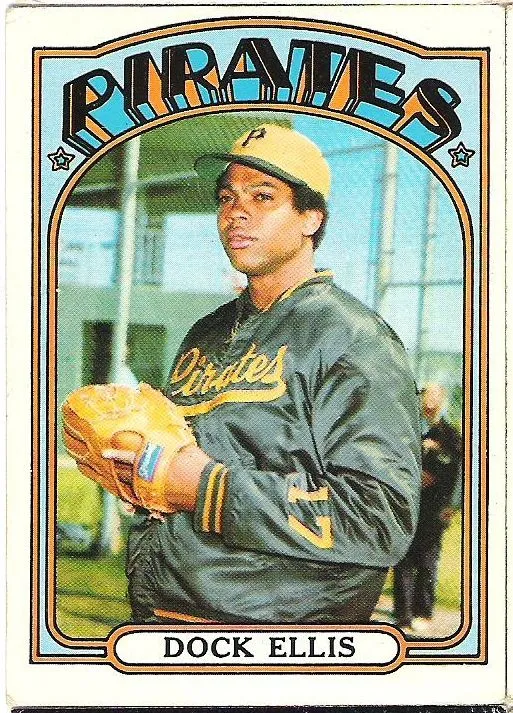
[Q] It is with respect and admiration that I share my revelation with you. Everyone from our planet knows about the Dock Ellis on acid no-hitter. There are songs, books and probably t-shirts and buttons. But did you, or anyone, till me, notice that in the box score that day was the line: Ellis, D. pitcher ( LSD !!!!)
[A]
Thank you!!!
October 19, 2022
On identifying left Democrat but not audiophile, rooting for Harry Styles, missing Gram Parsons, avoiding the b-word, and loving Canada (but not the Tragically Hip)
[Q] Were you always a pablum-puking liberal or did you have to be brainwashed? -- Ronald Regan, Austin, Texas
[A]
I was raised in a born-again Christian family in Queens, Republicans
though never true conservatives who like most Americans came to think
the Vietnam War was a mistake. I started moving away from Christianity
in my early teens, explicitly espousing atheism at 17. Influenced by
several women I cared for, prominently including the two referred to
in the Canada question below, I became a leftist in the '60s and would
now label myself a "left Democrat" because I believe the word
"progressive" has lost most of its mojo. I thank you for giving me an
excuse to remind And It Don't Stop readers that there are crucial
elections taking place November 8, perhaps as crucial as any we've
known, and to urge them to vote as soon as possible as well as donate
to favored candidates, as I have to over a dozen since March or
so. Never since World War II has democracy been in so much peril.